

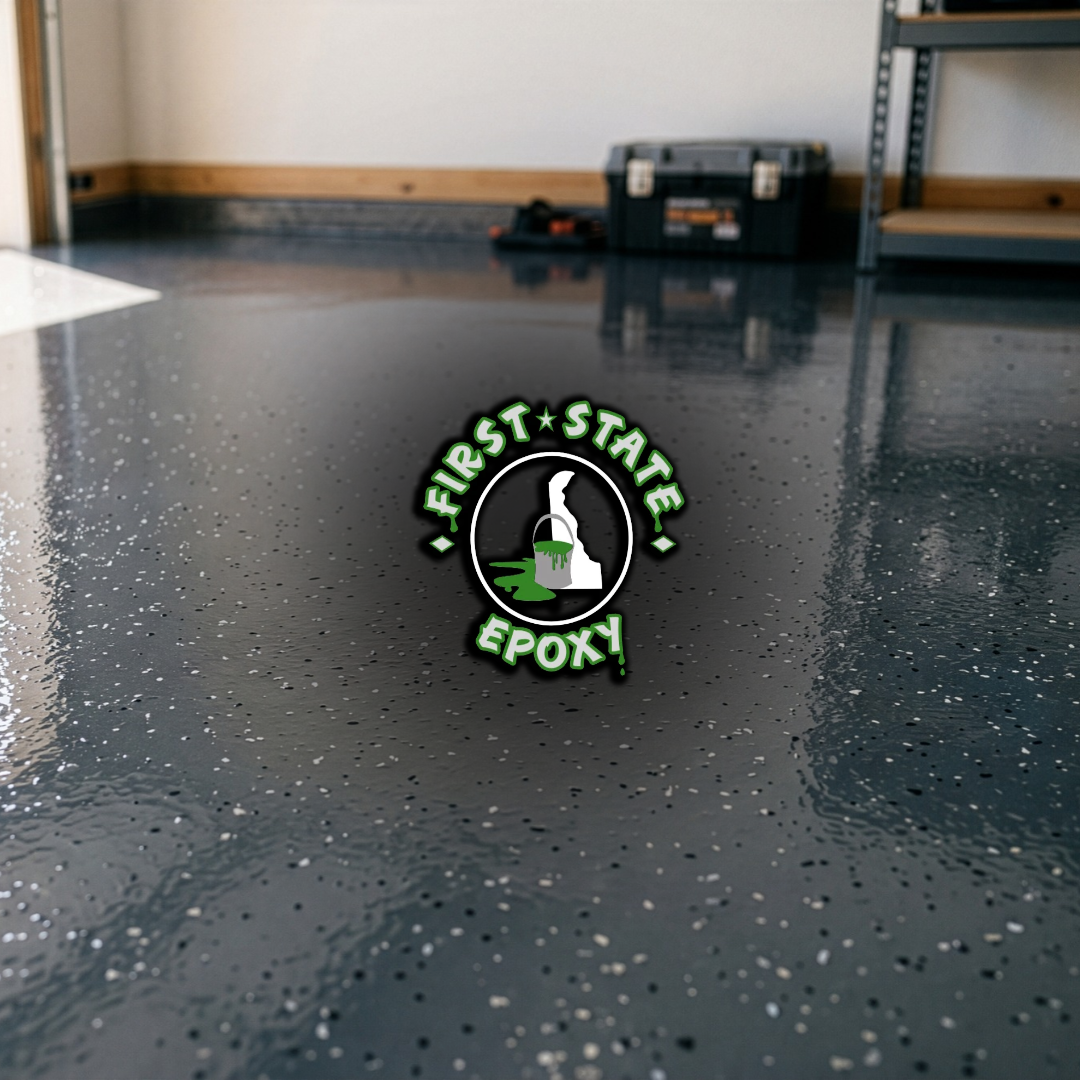
If you’ve been researching garage floor coatings for your Delaware home, you’ve probably encountered two popular options: polyaspartic and epoxy flooring. Both can transform an unfinished concrete garage into a durable, attractive space, but they aren’t identical.
Traditional epoxy has been used in residential and commercial flooring for decades. Polyaspartic coatings have gained attention for their fast curing, UV stability, and performance in demanding environments.
So, is polyaspartic better than epoxy for garage floors?
The answer depends on your concrete, how you use your garage, and the complete flooring system being installed. Understanding the differences can help you make a more informed investment rather than choosing a coating based on advertising claims alone.
For homeowners throughout Delaware, including Wilmington, Newark, Middletown, Dover, and surrounding communities, here’s what to consider before selecting a professional garage floor coating.
What Is an Epoxy Garage Floor Coating?
Epoxy is a resin-based coating commonly applied to properly prepared concrete surfaces. It has a long history of use in residential garages, warehouses, automotive facilities, and commercial buildings.
When installed correctly, professional epoxy flooring can provide a durable protective surface with excellent adhesion and a variety of decorative options.
Common benefits of epoxy garage flooring include:
- Strong adhesion to properly prepared concrete
- Good resistance to abrasion and everyday wear
- Resistance to many automotive fluids and chemicals
- Decorative flake and solid-color options
- A seamless, easy-to-clean finish
- Proven performance in residential and commercial applications
However, not all epoxy products perform equally.
Professional-grade epoxy coatings can differ significantly from inexpensive DIY garage floor kits in formulation, thickness, preparation requirements, and overall durability.
Certain epoxy formulations can also yellow or discolor after prolonged exposure to ultraviolet light, making sunlight exposure an important consideration.
What Is a Polyaspartic Garage Floor Coating?
Polyaspartic is a coating technology commonly used in high-performance concrete flooring systems.
Polyaspartic coatings are a type of polyurea chemistry, although the two terms are not interchangeable across every product or formulation.
These coatings are particularly popular for garage floors because of their fast curing characteristics, UV stability, and resistance to everyday wear.
Common advantages of polyaspartic garage flooring include:
- Excellent UV stability
- Strong abrasion resistance
- Resistance to many common garage chemicals
- Faster curing than many traditional epoxy systems
- Decorative flake compatibility
- Durable clear topcoat options
- Easy routine cleaning
Polyaspartic coatings can be used in different system configurations, including as protective topcoats over decorative flake flooring.
For Delaware homeowners who want a durable, attractive finish with less potential for sunlight-related yellowing, polyaspartic is an option worth considering.
Polyaspartic vs. Epoxy Garage Floors: Key Differences
Although both coatings can produce beautiful garage floors, their performance characteristics vary.
1. Durability and Abrasion Resistance
Both professional epoxy and polyaspartic coatings can provide excellent durability when properly specified and installed.
Polyaspartic products are frequently selected for their abrasion resistance and ability to perform as protective topcoats.
Epoxy can also offer strong wear resistance, particularly when used as part of a properly designed multilayer system.
The takeaway: Neither material is automatically more durable in every application. Product formulation, coating thickness, concrete preparation, and installation quality all matter.
2. UV Resistance and Yellowing
One of the clearest distinctions between traditional epoxy and many polyaspartic coatings is UV stability.
Certain epoxy products can develop a yellow or amber appearance after extended sunlight exposure.
Aliphatic polyaspartic coatings generally provide better color stability under UV exposure, making them attractive for garages where sunlight enters through open doors or windows.
The takeaway: Polyaspartic often has an advantage when maintaining color and clarity in sunlight is a priority.
3. Installation and Curing Time
Traditional epoxy systems may require longer curing periods before they can tolerate normal vehicle traffic.
Many polyaspartic products cure considerably faster, potentially allowing a professionally installed floor to return to service sooner.
However, faster curing doesn’t automatically mean every polyaspartic floor can be completed in one day.
Installation time depends on the specific products, concrete condition, repairs, temperature, humidity, and number of coating layers.
The takeaway: Polyaspartic often offers faster curing, but homeowners should follow the installer’s specific return-to-service instructions.
4. Chemical and Stain Resistance
Garages encounter oil, automotive fluids, road salt, dirt, water, and other contaminants.
Both epoxy and polyaspartic coatings can provide chemical resistance, although performance varies by product and the substance involved.
For example, resistance to motor oil doesn’t automatically guarantee resistance to every solvent, cleaner, or automotive chemical.
The takeaway: Both technologies can protect garage concrete from common contaminants when the correct system is selected.
5. Appearance and Decorative Options
Both epoxy and polyaspartic systems can create attractive garage floors.
Popular finishes include solid colors, decorative flakes, and glossy or satin appearances.
Full-broadcast flake systems are especially popular because they create a consistent decorative finish while helping disguise minor visual variations in the underlying concrete.
The finished appearance often depends more on the decorative system and topcoat than on whether the underlying material is epoxy or polyaspartic.
The takeaway: Both can deliver an attractive finish, with polyaspartic offering additional advantages for UV-stable clear topcoats.
Polyaspartic vs. Epoxy: Quick Comparison
| Feature | Epoxy | Polyaspartic |
|---|---|---|
| Durability | Excellent with proper installation | Excellent with proper installation |
| UV stability | Varies; some formulations yellow | Generally excellent |
| Cure time | Often longer | Often faster |
| Chemical resistance | Product-dependent | Product-dependent |
| Decorative flakes | Available | Available |
| Abrasion resistance | Strong | Strong |
| Concrete preparation | Essential | Essential |
| Maintenance | Relatively easy | Relatively easy |
The most important distinction is that you’re investing in a complete flooring system, not simply a product name.
Why Concrete Preparation Matters More Than Marketing Claims
A premium coating can still fail prematurely if it isn’t properly bonded to the concrete underneath it.
That’s why professional concrete preparation is one of the most important parts of any garage floor installation.
Concrete surfaces can contain oil contamination, old coatings, sealers, weak surface material, cracks, and other conditions that interfere with adhesion.
Mechanical grinding is commonly used to prepare concrete and create the appropriate surface profile for a coating system.
Professional preparation may also involve:
- Removing existing coatings and contaminants
- Evaluating cracks and previous repairs
- Addressing damaged concrete
- Assessing moisture-related concerns
- Preparing edges and difficult-to-reach areas
- Selecting materials compatible with the existing slab
A well-prepared concrete surface is essential whether the finished system uses epoxy, polyurea, polyaspartic, or a combination of technologies.
Where Does Polyurea Fit Into Garage Floor Coatings?
Polyurea is another important term homeowners may encounter while comparing professional garage flooring companies.
Polyurea coatings are available in multiple formulations, with different curing speeds, flexibility, and performance characteristics.
Polyaspartic coatings belong to the broader polyurea family, but not every polyurea coating is polyaspartic.
Some professional garage flooring systems use a polyurea-based coating underneath decorative flakes and a polyaspartic topcoat for additional surface protection.
Other systems use different combinations of materials.
Rather than assuming every polyurea or polyaspartic system is identical, homeowners should ask their contractor which products are being installed and how the individual layers work together.
Which Garage Floor Coating Is Best for Delaware Weather?
Delaware garages experience a combination of summer heat, humidity, winter temperatures, rain, road salt, and seasonal changes.
Vehicles frequently carry water, dirt, and road contaminants into the garage, while open garage doors can expose portions of the floor to direct sunlight.
These conditions make several coating characteristics particularly important:
- UV stability for sun-exposed areas
- Resistance to common automotive contaminants
- Abrasion resistance from vehicle and foot traffic
- Appropriate traction when the floor becomes wet
- Strong adhesion to properly prepared concrete
Polyaspartic coatings can be particularly attractive for Delaware garages where sunlight exposure and faster curing are priorities.
However, the existing slab and how the garage is used should always influence the final recommendation.
Are Polyaspartic Garage Floors Worth the Investment?
A professionally installed garage floor coating can do more than improve the appearance of unfinished concrete.
It can create a finished surface that is easier to clean, more resistant to everyday contaminants, and better suited to how homeowners use their garages.
For many homeowners, the value comes from a combination of benefits:
- A cleaner, more finished garage appearance
- Easier maintenance
- Protection for the concrete surface
- Decorative colors and flake options
- Resistance to common garage wear
- Long-term usability
Polyaspartic systems may have a higher initial price than some traditional epoxy options, but project costs depend on the complete installation.
When comparing estimates, homeowners should evaluate concrete preparation, coating materials, system thickness, warranty terms, and installation quality rather than price alone.
For a broader comparison of garage flooring options, explore our guide to the best garage floor coatings for Delaware homes.
Choosing a Professional Garage Floor Coating Contractor in Delaware
Choosing the right installer is just as important as choosing the right coating technology.
A knowledgeable contractor should be able to explain the preparation process, recommend an appropriate flooring system, and answer questions about long-term maintenance.
Before selecting a contractor, consider asking:
- What coating system will be installed?
- Is the base coat epoxy, polyurea, or another material?
- Will a polyaspartic topcoat be used?
- How will the concrete be prepared?
- How are cracks and existing damage addressed?
- What is the expected curing time?
- What decorative finishes are available?
- What warranty coverage is provided?
At First State Epoxy, we help Delaware homeowners explore professional garage floor coating solutions designed around their concrete, desired appearance, and everyday needs.
You can also browse our completed flooring projects to see examples of decorative finishes and transformations.
Frequently Asked Questions About Polyaspartic and Epoxy Flooring
Polyaspartic coatings often offer advantages in UV stability and curing speed, while professional epoxy systems can provide excellent adhesion and durability. The best choice depends on the concrete, environment, and complete flooring system.
A professionally installed polyaspartic coating can provide many years of service. Its lifespan depends on concrete preparation, product formulation, traffic, chemical exposure, and maintenance. No single lifespan applies to every installation.
Aliphatic polyaspartic coatings generally offer excellent UV stability and are less prone to sunlight-related yellowing than many traditional epoxy formulations. Performance still depends on the specific product.
Often, yes. Existing concrete must first be evaluated for cracks, contamination, moisture concerns, and surface deterioration. Proper repairs and mechanical preparation may be necessary before coating.
Polyaspartic coatings are a type of polyurea chemistry, but not every polyurea product is polyaspartic. Different formulations offer different curing characteristics and performance properties.
Pricing depends on garage size, concrete condition, preparation requirements, repairs, decorative finishes, and the coating system selected. A professional estimate provides the most accurate pricing for your specific garage.
Upgrade Your Garage with First State Epoxy
Whether you’re renovating an older garage or finishing a new concrete floor, selecting the right coating system can make a significant difference in appearance, maintenance, and long-term performance.
First State Epoxy provides professional garage flooring solutions for homeowners throughout Wilmington, Newark, Middletown, Dover, Smyrna, Bear, Hockessin, and surrounding Delaware communities.
From concrete preparation to decorative finishes, our team helps homeowners select a flooring solution suited to their space.
Ready to transform your garage?
Request a Free Garage Floor Coating Quote and explore your options with First State Epoxy.



No responses yet